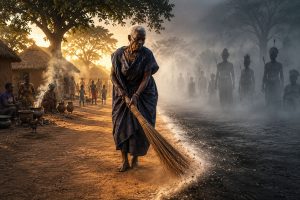
I have often been asked why my novels refuse to remain in one country, one century, or one civilization. Readers finish a story set in ancient Egypt only to discover that the next journey lbegins in the Kingdom of Dagbon in 1842. From there they may find themselves walking through the streets of eighteenth-century Sri Lanka. Standing beside a healer in colonial Nicaragua. Following a widow through the markets of Accra in 1978 or crossing another forgotten corner of the world.
The answer has always been the same. The world is my chessboard. Every novel begins with a single move.
A chess player does not wander across the board without a purpose. Every move is strategic. Each square offers a different challenge and reveals another way of understanding the game. I approach history in much the same way. Before I write a single chapter, I choose a place, a people, and a moment in time that deserve to be understood on their own terms. I remain there until I have listened carefully to the tempo of everyday life, studied the customs that shaped a community, and learned how ordinary people worked, loved their families, mourned their dead, celebrated their victories, believed in their religions, and endured the harships. Only then do I make my next move.
I do not write to collect countries. Neither do I write to display historical knowledge. My purpose is to restore dignity to lives that history often leaves in the background. Empires rise and fall. Kings and generals fill the pages of textbooks. Yet history has always belonged just as much to the market woman who measured grain beneath the morning sun. The potter whose hands shaped vessels for an entire village. The fisherman who trusted the sea before dawn. The healer who carried generations of knowledge in his memory. The mother who held a family together when everything around her began to fail and the child whose name was never recorded although countless futures depended upon that life. Those are the people I raise from the dead .
Every civilization possesses stories that deserve patience over assumption. All cultures deserve to speak with their own voice. Each landscape asks to be understood before it is described. That responsibility demands research, humility, observation, and respect. Imagination gives life to the people who inhabit my novels, but it is history that determines the ground beneath their feet.
Readers sometimes ask who my opponent is that sits on the other side of the board. The answer is yester year itself.
Time has always buried ordinary lives beneath the ruins of the past. Languages have disappeared. Traditions fade. Villages abandoned. Memories become fragmented leaving behind only scattered traces of those who once laughed, worked the fields, struggled, worshipped their gods, sacrificed, and dreamed. Every novel I complete is my attempt to recover the residue of those voices before they vanish beyond recognition. That is the game I have chosen to play.
Many writers spend a lifetime exploring one landscape. My journey carries me across many. Every completed novel becomes another square occupied on the board. Every unwritten story waits patiently on another square, inviting the next move. I already see many moves ahead. My task is not to search endlessly for ideas. The task is to honour each story with the time, discipline and care it deserves before placing it upon the board.
The game has no final move because history does not have a last page. Somewhere in the world another forgotten life waits beneath the dust of forgotteness. A different culture holds a story that deserves to be remembered. Another generation has left behind a voice that still longs to be heard.
As long as those stories remain, another square waits. The world is my chessboard. Every novel is another move across human history.